Practice Makes Policies: Bootstrapping and Consolidating
Robotic Capabilities from Zero Human Demonstrations

Jialiang Li1, Yuhan Wang1, Haojun Li1, Gaojing Zhang2,
Yangtian Ye1, Qipeng Liu1, Haotian Liang1, Wenzhao Lian1
1Shanghai Jiao Tong University, 2University of Sussex
lijl25@sjtu.edu.cn
HERO Framework Overview

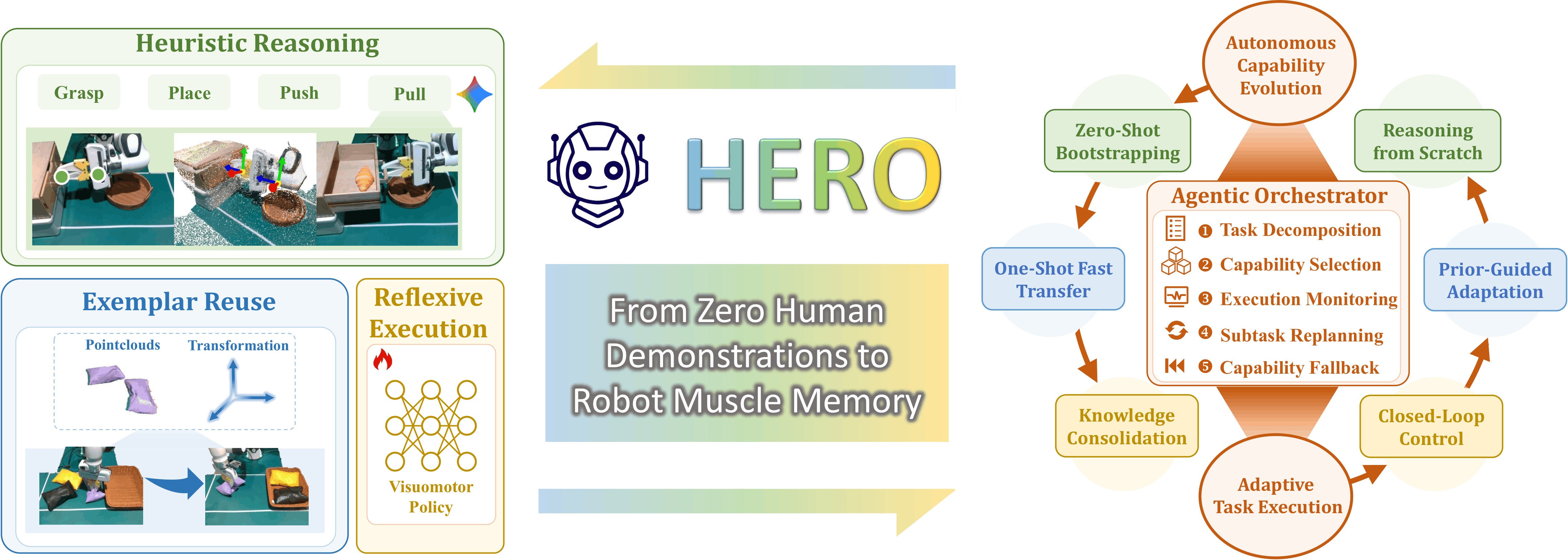
HERO enables robots to autonomously bootstrap, accumulate, and consolidate manipulation capabilities — all from zero human demonstrations.

Abstract

General-purpose robotic manipulation requires robots to perform diverse tasks in open-world environments while improving their skills over time. Despite recent progress, existing systems acquire manipulation skills in a static manner, where capabilities are learned for specific tasks rather than adaptively evolving through physical interaction.

Resembling how repeated practice enables humans to develop muscle memory, we propose HERO, a self-improving hierarchical embodied agent that enables autonomous capability evolution from zero human demonstrations. HERO organizes Heuristic reasoning, Exemplar reuse, and Reflexive execution into a unified Orchestration framework, allowing robots to autonomously bootstrap manipulation experience, rapidly accumulate reusable behaviors, and progressively consolidate recurring interactions into efficient closed-loop visuomotor policies.

Extensive experiments across four real-world tasks demonstrate that HERO substantially reduces human intervention during data collection while achieving robust manipulation, providing a promising path toward self-improving robotic systems.
Demonstration Videos

Autonomous Data Collection

HERO autonomously collects manipulation data across all four tasks.

L1 → L2 → L3 Capability Execution

From heuristic reasoning (L1), through exemplar reuse (L2), to reflexive visuomotor control (L3).

L3 Closed-Loop Visuomotor Policy

The distilled L3 policy performs reactive closed-loop control.

HERO Capability Hierarchy

L1 — Heuristic Bootstrapper

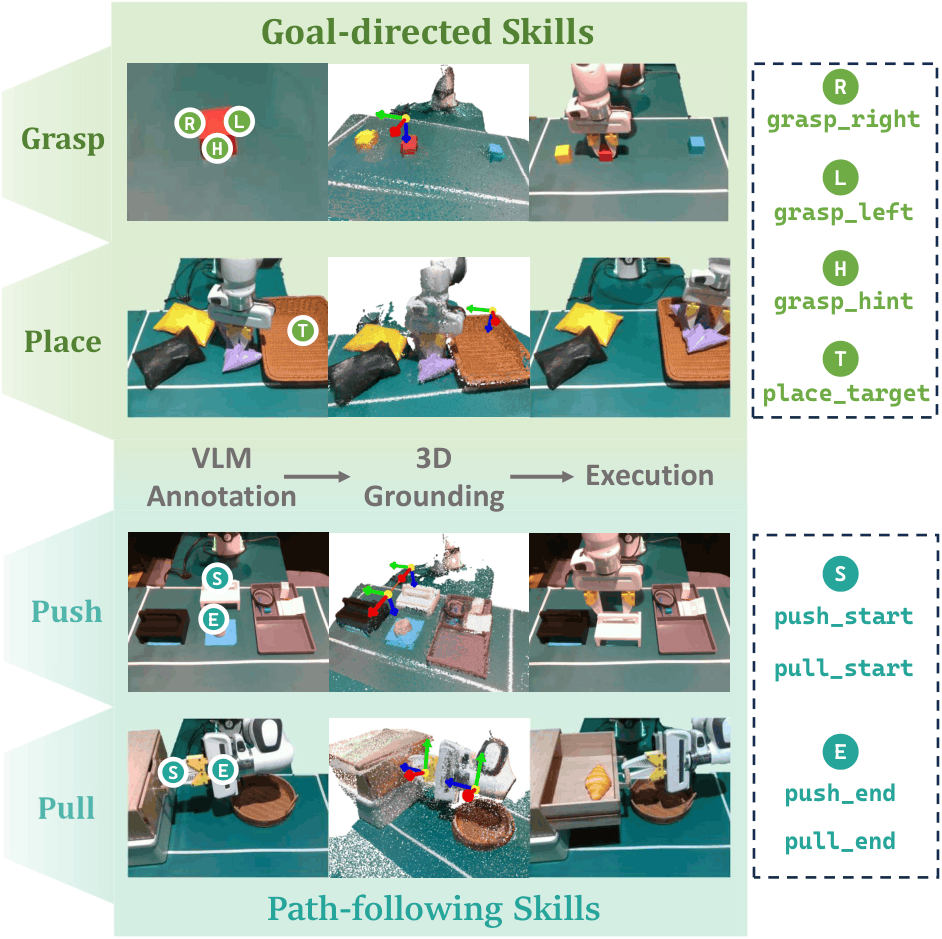
A zero-shot module that executes tasks without any human demonstrations. A VLM decomposes instructions into four primitive skills — Grasp, Place, Push, Pull — grounded in a 3D workspace reconstructed via Depth-Anything-3 from multi-view RGB.

L2 — Exemplar Accelerator

A one-shot module that accelerates execution by retrieving and warping similar past trajectories via rigid transformation, avoiding repeated VLM calls.

L3 — Reflexive Execution

An efficient closed-loop visuomotor policy distilled from accumulated experiences. Trained on autonomously collected data at 15 Hz, with automatic fallback to L2/L1 for robust deployment.

HERO Primitive Skills

Real-World Tasks & Results

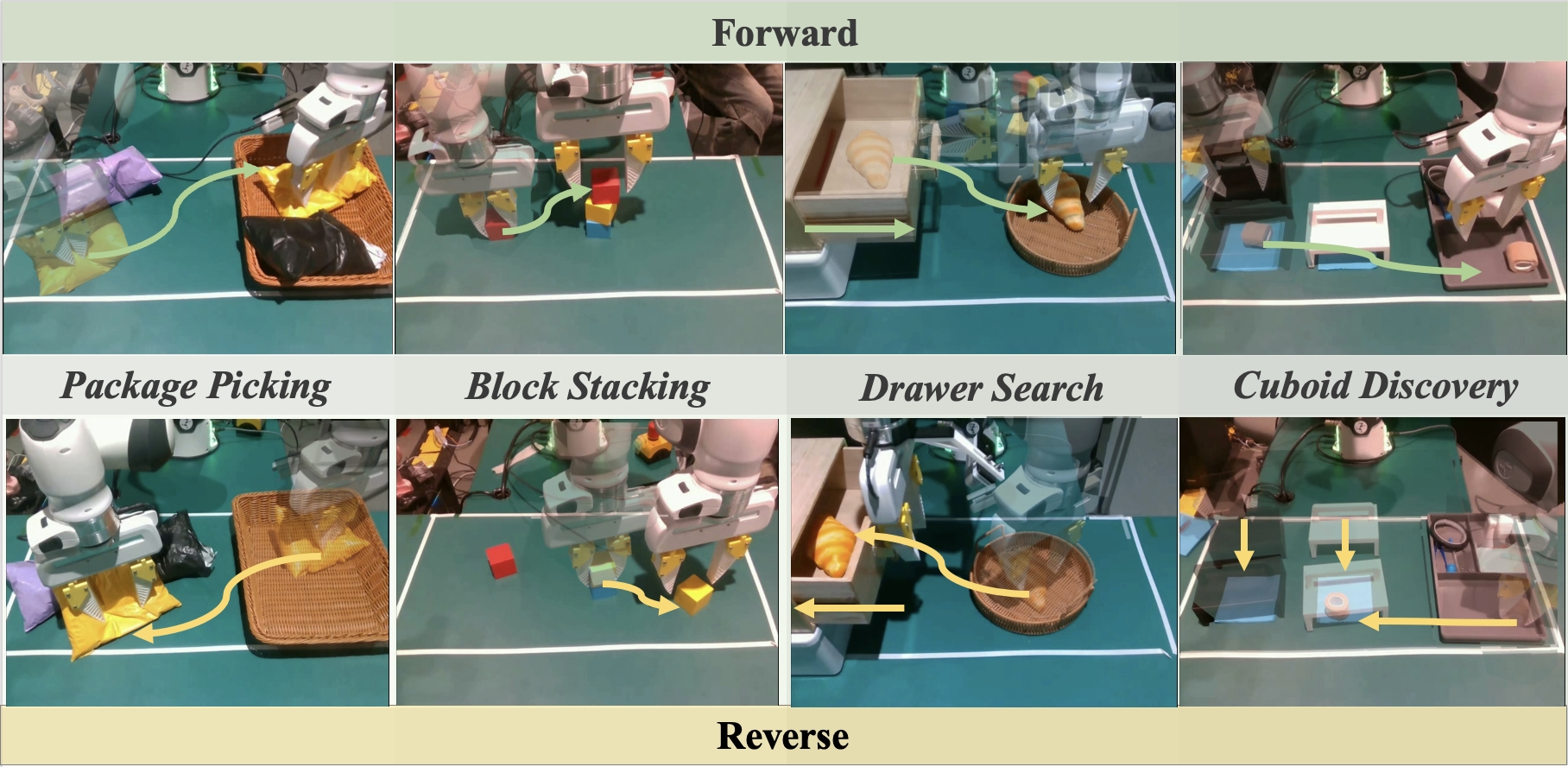
Four real-world manipulation tasks

Package Picking

Pick colored packages into a basket (reverse: return to table).

Block Stacking

Stack blocks by color sequence (reverse: unstack to table).

Drawer Search

Open drawer, retrieve hidden object (reverse: return & close).

Cuboid Discovery

Move cuboids to find hidden item (reverse: re-occlude).

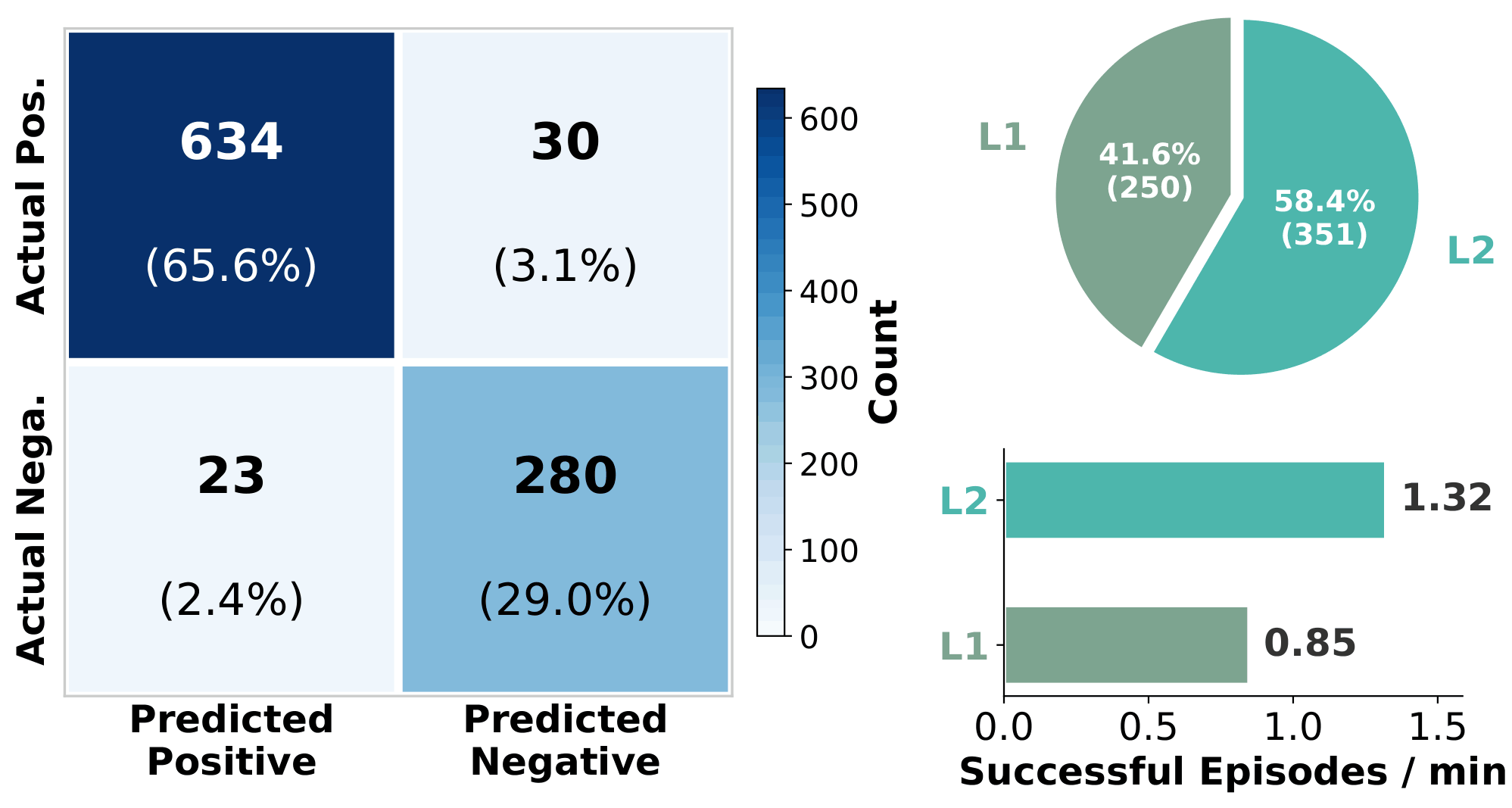
Starting from zero human demonstrations, HERO autonomously collects 664 forward and reverse subtask episodes across all tasks. Successful experiences are curated into L2 exemplars, and frequently recurring behaviors are distilled into L3 visuomotor policies (30 trajectories per task, 10,000 training steps). The orchestrator balances L1 and L2 contributions during data collection and dynamically schedules L3 → L2 → L1 with up to 3 retries during deployment.

Data Collection Results

BibTeX

@misc{hero2026,
  author    = {Li, Jialiang and Wang, Yuhan and Li, Haojun and
               Zhang, Gaojing and Ye, Yangtian and Liu, Qipeng and
               Liang, Haotian and Lian, Wenzhao},
  title     = {Practice Makes Policies: Bootstrapping and Consolidating
               Robotic Capabilities from Zero Human Demonstrations},
  year      = {2026},
  eprint    = {2607.26809},
  archivePrefix = {arXiv},
}